

This post may contain affiliate links. Please read my disclosure and privacy policy.
This post may contain affiliate links. Please read my disclosure and privacy policy.
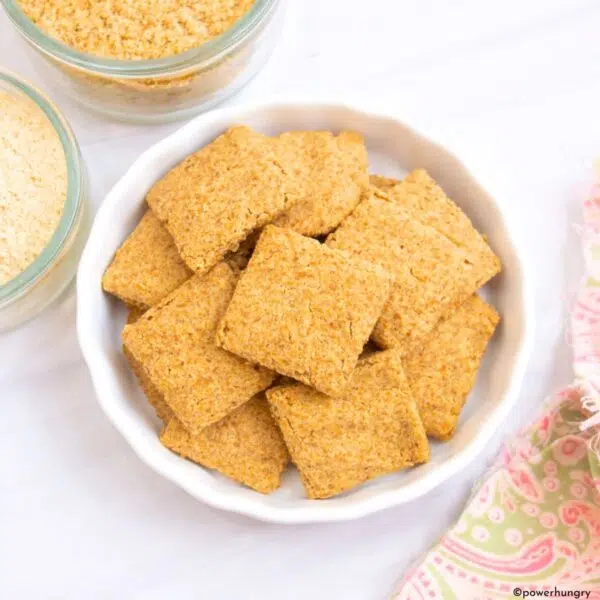
Easy no-roll cassava flour crackers, made with 2 ingredients (plus water & optional salt).They are vegan, grain-free, gluten-free, and super simple to make in little time.

Table of Contents
- Easy Grain-Free No-Roll Crackers
- Recipe Benefits
- Ingredients for the Cassava Flour Crackers
- What is Cassava Flour?
- Important Tip for Measuring Cassava Flour
- Step by Step Instructions
- Step One: Preheat the Oven & Prep a Baking Sheet
- Step Two: Whisk the Batter
- Step Three: Spread the No-Roll Cassava Flour Cracker Batter
- Step Four: Bake for 20 Minutes
- Step Five: Return Crackers to the Oven
- Step Six: Cool the Cassava Crackers
- Taste & Texture of No-Roll Cassava Flour Crackers
- FAQ
- How Should the No-Roll Cassava Flour Crackers be Stored?
- Can I Flavor the No-Roll Cassava Flour Crackers?
- Can These Be Made into Bigger Crackers?
- Is there a Way to Make These Crackers Even Crispier?
- Can I Use A Different Flour?
- Can I Make these Crackers Oil-Free?
- Related Recipes:
- Easy No-Roll Cassava Flour Crackers (vegan, grain-free) Recipe
Easy Grain-Free No-Roll Crackers
Crisp, crunchy crackers that are vegan, grain-free, gluten-free and made without rolling dough? That is exactly what my easy no-roll cassava flour crackers have to offer.
If you have 30 seconds to whisk the batter, and a minute to spread it on a baking sheet, you have time to make a batch of these delicious crackers!

Recipe Benefits
My easy no-roll cassava flour crackers are:
- Made with 2 ingredients (plus water & optional salt)
- Vegan (egg-free & dairy-free)
- Grain-free
- Gluten-free
- Sugar-free
- Paleo
- Quick & easy to make in one bowl
- Frugal
- Made without rolling dough (simply spread the batter)
- Customizable (add in, or top with, extra ingredients)
They are seriously good!

Ingredients for the Cassava Flour Crackers
The exact amounts of each ingredient are indicated in the recipe card at the end of the post. Toggle between US Customary (volume) and Metric (weights) for preferred measurement option.
To make the crackers, you will need:
- Cassava flour (not to be confused with tapioca flour or tapioca starch)
- Neutral vegetable oil (e.g., avocado oil, olive oil, safflower oil)
You will also need regular tap water. I recommend adding salt, as well (I have specific amount recommendations in the recipe card, below), but it is entirely optional/adjustable.
You can flavor the crackers in many ways, too. I have a host of suggestions in the FAQ section at the end of the post.

What is Cassava Flour?
You may be brand new to using cassava flour. It is well worth knowing!
Cassava flour is a grain-free, gluten-free flour made from cassava (yuca root). Yuca root/ cassava is a starchy tuberous root commonly found in South American, African, and Asian cuisines. Tapioca is another product made from cassava.
Cassava flour is made by peeling, drying, and pulverizing the whole yuca root. Like wheat flour, it has a neutral flavor, which makes it wonderful to use in grain-free and gluten-free baking.
Important Tip for Measuring Cassava Flour

For best results, measure cassava flour by weight rather than cups.
Here’s why.
Cassava flour is tough to measure in standard cup measurements because it is so darn powdery (think talcum powder flying all over every surface consistency). It compacts even when lightly spooned into measuring cups. Thanks, cassava flour.
Moreover, what constitutes 1/4 cup of cassava flour varies from one manufacturer to another. Looking at 5 different brands (Bob’s Red Mill, Thrive, Otto’s, Terrasoul and Anthony’s) , the measurement for 1/4 cup of flour on the nutrition labels ranges from 30 grams to 35 grams (2 bags list 30 g, 2 bags 32 g, 1 bag at 35 g).
In the world of baking, that is huge difference that can create dramatically different results. Based on the different brands, a standard cup of cassava flour can vary from 120 grams to 140 grams!
If cassava flour was not so great for baking, I would say forget it. But it is, so carry on with these tips in mind:
- 1/4 cup of cassava flour is 32 grams (1 cup = 128 grams; middle ground of the various brands)
- If using a cup measure, do not fill to the top of the cup!
- For greatest accuracy, use a digital kitchen scale to measure
Step by Step Instructions
Note that the complete directions are also in the recipe card below.
Time to make some crackers, friends!
Step One: Preheat the Oven & Prep a Baking Sheet
Preheat the oven to 350F (180C). Line a large, rimmed baking sheet with parchment paper (it works better than spraying the pan or greasing the pan).
The large baking sheet I use (day in and day out) is a standard half sheet pan, which is a heavy pan measuring 18 x 13 inches (45 x 32.5 cm).
If your pan is smaller than a half sheet pan, your crackers will be thicker and will need a longer bake. If needed, divide the batter into several smaller metal pans (e.g., cake pans, square pans).
Step Two: Whisk the Batter
In a medium bowl, whisk the cassava flour, water, oil and optional salt. That was easy!
The thickness of the batter should be right in between the thickness of pancake batter and crepe batter In other words, Goldilocks thickness: not too thick, not too thin.
No need to panic if the batter is too thick or thin: simply add more water, or a small amount more cassava flour, as needed.

Step Three: Spread the No-Roll Cassava Flour Cracker Batter
Pour all of the no-roll cassava flour cracker batter onto the prepared baking sheet (note: this is a half sheet size, (18x3x1 inch/ 45×7.5×2.5 cm)

Use a spatula to spread the batter into an even layer that covers almost all of the parchment paper.
An offset spatula works especially well for spreading the batter. if you have one, use it. Otherwise, a regular silicone spatula, or even the back of a large spoon, will work fine.

Step Four: Bake for 20 Minutes
Bake the crackers in the preheated oven for 20 minutes.
Remove the baking sheet from the oven (keep the oven on). Using a pizza cutter, knife, or a metal pastry cutter, cut the crackers into squares (or whatever shape you desire). I cut mine into 10 x 7 rows for 70 crackers.
It is not difficult to cut through the crackers. Moreover, it is not necessary to cut all the way through. So long as the crackers are at least deeply scored (i.e., cut part-way through), they will break off with ease post-bake.
As you can see from my photo, I did not worry about cutting perfect shapes :). You should not, either.

Step Five: Return Crackers to the Oven
Return the cut crackers to the oven and bake for another 25 to 30 minutes until light golden brown and crispy (they will look dry, and also feel firm to the touch).
Begin checking for doneness at the 25 minute mark.
The crackers on the outer edge of the sheet pan tend to brown more quickly than the crackers towards the center. Break off (at the cut lines) any crackers that are already golden brown and crisp (transfer to a cooling rack or plate). If any crackers need an additional few minutes of baking, keep them on the baking sheet and return to the oven until they are similarly crisp and golden brown.
Step Six: Cool the Cassava Crackers
Use the parchment paper to remove the crackers to a cooling rack or cutting board and cool completely. Break the crackers along their cut lines.

Taste & Texture of No-Roll Cassava Flour Crackers
The flavor of the crackers is remarkably similar to crackers made with all-purpose flour. It makes them perfect for general munching, or for pairing with a bowl of soup, dunking into a favorite dip, or pairing with a favorite cheese. I strongly recommend my so-easy Cashew Boursin (spreadable garlic-herb cheese). It’s a match made in heaven).
The crackers have a sturdy, crunchy texture–they are very satisfying when you are in need of a salty snack.

FAQ
How Should the No-Roll Cassava Flour Crackers be Stored?
Store the cooled crackers in an airtight container at cool room temperature for 2 weeks or the freezer for up to 6 months.
Can I Flavor the No-Roll Cassava Flour Crackers?
Yes!
(1) Add Herbs or Spices to the Batter
Whisk your favorite herbs or spices directly into the batter. About one to one and a half teaspoons for most dried herbs and spices, for this quantity of batter, is a good general guesstimate.
Fresh chopped herbs can also be added to the batter. Add up to two tablespoons of mild herbs, such as parsley, cilantro, or basil. For stronger herbs, such as rosemary, oregano or thyme, add 1 to 2 teaspoons maximum.
(2) Flavor with Liquids and Pastes
Consider adding wet flavor enhancers, as well. For example:
- Hot sauce
- Curry paste
- Tomato paste
- Tomato juice (in place of the water)
- Wasabi paste
(3) Sprinkle with Flavorful Toppings
You can also sprinkle toppings directly onto the batter after it has been spread out on the baking sheet. Some ideas include:
- Seeds (e.g., sesame, poppy, sunflower)
- Finely chopped nuts
- Chopped dried onion
- Everything bagel topping
- Flaky sea salt
- Cracked black pepper
Can These Be Made into Bigger Crackers?
Yes! You can cut the crackers any shape you like, and that includes cutting them into bigger sizes. The baking time stays relatively the same, so begin checking at the thirty minute mark on the second bake.
Is there a Way to Make These Crackers Even Crispier?
Yes! You can replace some of the water with additional oil. For every tablespoon of oil, reduce the water by 1 tablespoon.
Can I Use A Different Flour?
No, this recipe is specific to cassava flour so I cannot recommend any other flour as a replacement.
This includes tapioca starch/flour. Both cassava flour and tapioca are derived from the yuca (cassava) plant. However, the two products are processed differently and work in different ways in baking and other recipes.
Can I Make these Crackers Oil-Free?
I do not recommend it for this recipe.
You could replace the oil with more water (I have not tried it), but the crackers will not be crisp or tender. I suspect they would be fairly hard.
Another option could be to replace some of the water with a high fat liquid, such as full-fat coconut milk. I have not tried it, but it could be worth experimenting.
Related Recipes:

Easy No-Roll Cassava Flour Crackers (vegan, grain-free)
Equipment
- 1 Large Baking Sheet (half sheet size, (18x3x1 inch/ 45×7.5×2.5 cm)
Ingredients
- 128 grams cassava flour, (a scant 1 cup of flour)
- 1 cup water
- 3 tablespoons neutral vegetable oil, e.g., avocado oil, olive oil
- Optional, but recommended: 1/2 teaspoon salt, (add more or less, to your preference)
Instructions
- Preheat the oven to 350F (180C). Line a large baking sheet with parchment paper.
- In a medium bowl, whisk the cassava flour, water, oil, and optional salt until smooth.
- Pour the batter onto the prepared baking sheet. Spread in an even layer to cover almost all of the parchment paper.
- Bake in the preheated oven for 20 minutes. Remove the baking sheet from the oven. With a pizza cutter, knife, or metal pastry cutter, cut or score the crackers (I cut 10×7 rows).
- Return the baking sheet to the oven and bake for another 25 to 30 minutes until golden brown and crisp. If the crackers on the outer edge are darkening faster, break them off at the cut lines and cool; continue baking the remaining crackers until done.
- Use the parchment paper to remove the crackers to a cooling rack or cutting board. Cool completely and then break along the cut lines.


Wow- thank you! Crackers that I can eat on my AIP diet! I was a little skeptical, but these turned out great! Someone previously talked about Azure Standard Cassava flour – which is what I have. My batter was thin after weighing and whisking so I added a little more flour and crossed my fingers! Your instructions are spot on! Can’t wait to make another batch with different seasoning.
Wonderful, Lisa! I am so happy that the crackers were a success 🙂
The ratio of cassava flour to water is spot on! I followed your recipe exactly, and turned out very nice. Some were a bit chewy, I wonder if adding a touch of baking soda would help? I also found that after I removed crackers from the oven, took off the edge ones which were excellent, returned the rest to the oven ( oven off) and let them just dry out a bit more, they were golden brown already. This finished them beautifully. Thank you for your recipe.
You are very welcome, Sandra!
These are silly easy to make and really tasty! Ijust struggled knowing how thick the batter should be. My oven is small, so l used two half trays and spread the batter to near edges of each tray. Some of the middle crackers were a little thick so I baked them longer as described in the instructions. What is the ideal thickness because I will definitely make them again!
I am so glad that you like the crackers, Natalia. You cannot exactly measure the thickness, because it is pretty thin. But you can follow my pan guidelines: I use an 18x3x1 inch size standard half sheet pan. I spread the batter out to all the way, leaving about 3/4 inch border all around. The key is to make sure you spread the batter out from the middle to the edges, so that all of the batter is the same thickness. Hope this helps!
These crackers are the best. I love working with cassava flour, my parents used it a lot in their cooking. This is how it should be used for simple flatbreads and such. It is hard to find other vegan recipes that do not combine cassava flour with another flour! The texture is crispy and perfect. The only downside is it is hard to stop eating them! Thank you!
I am so glad that you like the simplicity of the crackers, Abidemi!
They are delicious. I made them very thin and crispy. Love the flavor. They even taster better the next day.
I am so glad the cookies were success, Pammer! L)
Really bummed but this did not work well for me at all. I weighed the cassava flour carefully on a scale I know to be accurate and also very carefully measured my water volume but the batter was like skim milk. I ended up having to shovel in probably as much flour as I had put in initially to get something close to a crepe batter. At that point I poured it onto the sheet and was able to spread it out just by tipping the sheet. After baking, scoring, and baking again, there was no browning on top so I bumped up the temperature to 375 and gave it at least another 20 minutes (beyond the 50 minutes in the recipe) at which point the tops were very lightly beginning to brown. When I pulled them out, the bottoms were very brown. Tasting them, they were a bit bitter in the aftertaste and though crunchy at the beginning, they were more gummy at the end. Just not very pleasant. Maybe it was the brand of flour I used, but they were not as pretty as on this webpage.
Hi LZ,
Oh no, I am so sorry the recipe caused so many headaches. I am trying to figure out what could have gone so awry to get the results you describe since this is a go-to recipe that I make at our house.
You mention needing to add almost twice the amount of flour to get a batter close to crepe consistency. That would be almost 2 cups of flour to 1 cup of water. Even with the added oil, that would be a very thick paste. Just comparing ratios of liquid to flour in many non vegan crepe recipes, there is as much as 2 cups liquid + eggs ton1 cup flour. I know you mention carefully weighing the cassava flour, so my guess is that you may have accidentally added 2 cups water instead of oil. Then adding the extra cup or so of flour would make sense. However, then the ratio of oil would be off. There would also be about twice as much batter, so the crackers would be thicker ,which would explain need to more than double the bakinv time snd increase the temperature).
Hi Camilla thank you for another fantastic recipe! I have made these a few times and they’re always a hit; such great flavour! I’ve added rosemary and garlic in two batches, may add cinnamon a sprinkle with sugar for a batch. Thank you so much!
I am surprised how delicious these turned out! I think it was the great explanation on measuring the flour. Will be making these again!
I am so happy you like them Shelley!
Can I use buckwheat flour, amaranth flour, brown rice flour, millet flour, or sorghum flour instead of cassava flour? I saw your oat crackers, yet I do not bake with nuts or seeds, maybe I can sub with more oat flour and oil?
Hi Nicole,
I am not sure whether those would work as a 1:1 substitute. It may take some tinkering with each flour to determine the amount of water and oil needed for each, as well as any differences in baking times (and, possibly, any differences needed in temperature).
I have been making this recipe for two years now. I’ve tried multiple herbs, spices, and seasonings. I enjoy them all. I highly recommend weighing the flour vs just using a measuring cup. Thank you!
So happy to know these have become part of your repertoire, Holly :). Thank you for emphasizing weighing the flour, I couldn’t agree more (takes out any guesswork for accuracy). Cheers :).
OMG these are delicious! I added some dried rosemary from our garden. Next time I’d add a bit more salt. I’m on a low-histamine diet and have been craving something crunchy! Thank you so much for all your interesting recipes. I’ll be making these regularly. I’m sprouting some garbanzo beans to make humus and these will be perfect with it!
I am thrilled you like the crackers so much, Dana! They remind me of wheat thins from days past (but better!). Yes, play with different flavors to yur heart’s content 🙂 Sprouted hummus sounds like a fab accompaniment!
Hi! I just tried the Cassava cracker recipe but it didn’t turn out like your photo… the top was ok, but the back that was against the parchment turned gooey and shiny. I flipped it and kept baking it. What did I do wrong?
Hi Joanne,
Oh no, so sorry you had issues with the crackers. I am wondering, did you see that there are two bakes? First you bake part way (20 minutes), then you cut the crackers and bake again for 25 to 30 minutes. You mentioned that you flipped “it” which made me think maybe you turned over the entire cracker before cutting and baking the second time? The crackers will definitely be underbaked after only 20 minutes.
If the crackers were still gooey after 45 to 50 minutes of baking, then it might be that they were spread thick (smaller pan than a half sheet size, which is 18x3x1 inches)? I spread the batter all the way out on the half sheet size so they are pretty thin.
I’ve made this three times and I love these crackers! They’re very crispy, kind of chip like when I male them. Is there a way to make them softer?
Hi Caitlyn! So glad you like the crackers. Hmm, regarding softness. I am not sure, but here are some of my guesses for what could work…maybe (1) try a slightly smaller baking sheet so they are a touch thicker, (2) substitute 1 tablespoon of cassava flour for 2 teaspoon coconut flour; (3) bake for a shorter time (a few minutes). I would love to know if you try one or more of these options!
Just made these. They are AWESOME thank you. Such a keeper and I can have crackers again.
Fantastic Connie! Crackers for all! 🙂
Brilliant recipe, so much easier than the one I’ve been making which needs rolling out.
Along with onion & garlic powder I added Cajun seasoning which made them look a little burnt underneath but they taste fantastic
Thank you ☺️
Wonderful, Manda! I am so glad you like the crackers (hurray for easy!). You flavor additions sound delish!
Hi Camilla,
I really appreciate your thorough and varied recipes that add considerably to my gluten-free, lectin-free food plan.
I’ve tried this recipe a few times, but the result is a thin almost translucent cracker. Tastes good, but has a weird texture.
What brand of Cassava Flour do you use?
Thank you,
Sandy
You are so welcome, Sandy. I am glad you like the crackers recipe, too.
It sounds, from your description, that there might have been too little cassava flour, which lead to a much thinner batter. I use Ottos cassava flour, but you should be able to make these with any brand. I strongly recommend weighing the flour as opposed to scooping, since it is so light and powdery. If the batter looks thin, simply add a little bit more cassava flour to thicken it 🙂
I Love this recipe! I added used 1 cup of bone broth as the liquid, and everything bagel seasoning on top. 5 stars!
Fantastic, Lynne! Count me in with the everything seasoning, I love it on so many things 🙂
hello! my mixture blew up like a big blister on the top. Ihad to popit and let it deflate. Is the mix too thick?
Hi KT,
Oh my, that sounds unusual! Did your batter resemble the consistency shown in the photos? Also, was the batter spread out thin to the dimensions mentioned in the post? Did the crackers come out ok otherwise?
I had to add more water, I did weigh the cassava flour. To me these are crunchy than crispy and if you need more of a chip than a cracker, something that really can hold up to dips this is great.
Great job trouble-shooting with the recipe, April. Glad you like it 🙂
These were perfect! I made them exactly as the recipe instructed and I cannot stop eating them! So delicious!
Yay! I love these crackers, too 🙂 My husband thinks they taste just like wheat thins .
@Courtney, yup! Agreed!!! ❤️????❤️????❤️
I loved these crackers
They were delicious. The only thing is I store them in an airtight container and the next day they were not crunchy and they were really hard to bite into.
Do you have any suggestions as to what could’ve happened? Could it be they were in cooked enough?
Hi Faye, so glad you enjoyed these! Yes, I thick you are correct about underbaking being the issue. Cassava flour can become weirdly hard (sort of hard-chewy—does that sound like the issue) if underbaked, especially for crusts and crackers. Also, I just want to check that they were spread thin (like wheat thins thin). Being too thick could also be a cause.
Can you use tapioca flour in place of cassava flour?
Hi Cindy,
Alas no, they are not interchangeable. Even though they are both made from cassava root, cassava flour uses the whole root while tapioca flour only uses the starchy pulp.
Love these!!!! Now I wonder if I could use chickpea flour , millet or buckwheat?
Thank you
Hi Amanda, I am so pleased that you like these! It would be worth a try with other flour— I may have to give it a try to let you know.
Very good. Aldo made some with poppy seeds. Do you have any recipes for Crackers using coconut flour
So glad you like them, Crystal! I don’t have a coconut flour cracker recipe, and your comment has made me wonder why I do not! I think I know what I need to do 🙂
Which brand of cassava flour did you use for your crackers? None of them seem to have the amount per cup that you recommend.
Apologies Betty, typo! It should have been 128 g for the 1 cup, not 148. Corrected.
I’ve tried to make this recipe, but when I follow it exactly I get a thick dough. I had to at least double the amount of water to make a batter. But they taste great!
Hi Maaike! Oh no, so sorry you ended up with a dough instead of a batter. I am curious, did you weigh the flour or spoon it into cups? Cassava flour is so very powdery, it is extremely easy to add too much to a cup since it compacts so much.
@Camilla, There are some brands of cassava flour that seem to absorb all of the liquid in a recipe and end up more dough-like than batter-like. I had this problem when I first tried using cassava. I was trying to make AIP Flatbread, like my friend was making, but it never came out like hers did. BUT she was using Anthony’s and I was using Azure Standard’s. Then I bought some Otto’s and, Voila, it worked! I have bought Otto’s ever since, and I have never had that problem again.
Thank you so much, Janet!
@Janet, some cassava flours go through a heating treatment while being dried, which causes the starches to pregelatinize, affecting the water absorption capability of the flour. If you want less absorbent flours, you should choose the ones dried at lower temps (: