

This post may contain affiliate links. Please read my disclosure and privacy policy.
This post may contain affiliate links. Please read my disclosure and privacy policy.
Ridiculously easy 100% millet pumpkin bread that is vegan, gluten-free, oil-free and so delicious. A hearty, fine-textured loaf, it is excellent plain or toasted.

Table of Contents
- Oil-Free Vegan Millet Pumpkin Bread
- What is Millet?
- Recipe Benefits
- Ingredients for Oil-Free Vegan 100% Millet Pumpkin Bread
- Sweetener Options
- How to Make 100% Millet Pumpkin Bread
- Step One: Preheat the Oven and Prepare the Pan
- Step Two: Blend Most (but not all) of the Ingredients
- Step Three: Whisk in the Remaining Ingredients
- Step Four: Spread Batter into Pan
- Step Five: Bake the Bread
- Step Six: Remove from Pan & Cool
- Slice it Thick or Thin
- What is the texture & taste of the 100% millet pumpkin bread?
- FAQ
- How should I store the 100% Millet Pumpkin Bread?
- Can I use millet flour in place of whole millet?
- Can I use a different grain in place of the millet?
- What kind of millet do you use?
- My oven has a convection setting. Should I use it for this bread?
- My bread came out gooey in the middle. Why?
- Can I Use Something Other than Whole Psyllium Husks?
- Related Recipes:
- 100% Millet Pumpkin Bread (V, GF, oil-free) Recipe
Oil-Free Vegan Millet Pumpkin Bread
This pumpkin bread is 100% in multiple ways. It is:
- Made with 100% millet (no other grains or flour)
- 100% delicious
- 100% filling
- & 100% inspired by my 100% Millet Banana Bread
Like my millet banana bread, this oil-free, vegan millet pumpkin bread is made from whole millet grain (although you can make it with millet flour, too).
This is a sturdy, not squidgy, loaf. Think of it as the love-child of a hearty, firm, German-style whole grain bread and a pumpkin spice latte. It toasts like a dream and makes a great sandwich bread, too (for example, with nut or seed butters, jam, sliced bananas, or chocolate hazelnut spread).
What is Millet?
Millet is a naturally gluten-free grain that is high in fiber, protein and antioxidants. Millet has a mild flavor (i.e., it goes well with many flavors) and is faintly reminiscent of cornmeal. It is also inexpensive.
Most importantly, millet makes most excellent pumpkin bread!

Recipe Benefits
- Oil-free
- Vegan (egg-free & dairy-free}
- Gluten-free
- Sugar-free
- Nut-free
- Xanthan gum-free
- Flourless (see my notes for using millet flour in place of whole millet)
- High in fiber
- Minimal ingredients
- Very fast & easy to prepare
Ingredients for Oil-Free Vegan 100% Millet Pumpkin Bread
The exact amounts of each ingredient are indicated in the recipe card at the end of the post.

The recipe ingredients are minimal (as a banana bread should be ?):
- unsweetened canned pumpkin puree
- whole millet (raw)
- whole psyllium husks
- coconut sugar (or the sweetener of your choice)
- vanilla extract
- cider vinegar (or any light-colored vinegar)
- pumpkin pie spice (or cinnamon; options are in the recipe notes)
- baking powder, baking soda, and salt
The recipe also uses plain water (I use filtered tap water).
Sweetener Options
An equal amount of brown sugar, or the granulated sweetener of your choice, can be used in place of the coconut sugar.
An equal amount of liquid sweetener can also be used. If using a liquid sweetener, decrease the total amount of water in the recipe by 2 tablespoons (30 mL).
How to Make 100% Millet Pumpkin Bread
Note that the complete directions are also in the recipe card below.
Step One: Preheat the Oven and Prepare the Pan
Preheat the oven to 350F (180C). If your oven has a convection setting, I recommend that you do not use it for this bread. This bread needs to be baked using the regular (convection) heat. More about this in the FAQS at the end of the post.
Spray a 9×5-inch (22.5 x12.5 cm) loaf pan with nonstick cooking spray. Alternatively, lightly oil or grease the pan.
Step Two: Blend Most (but not all) of the Ingredients
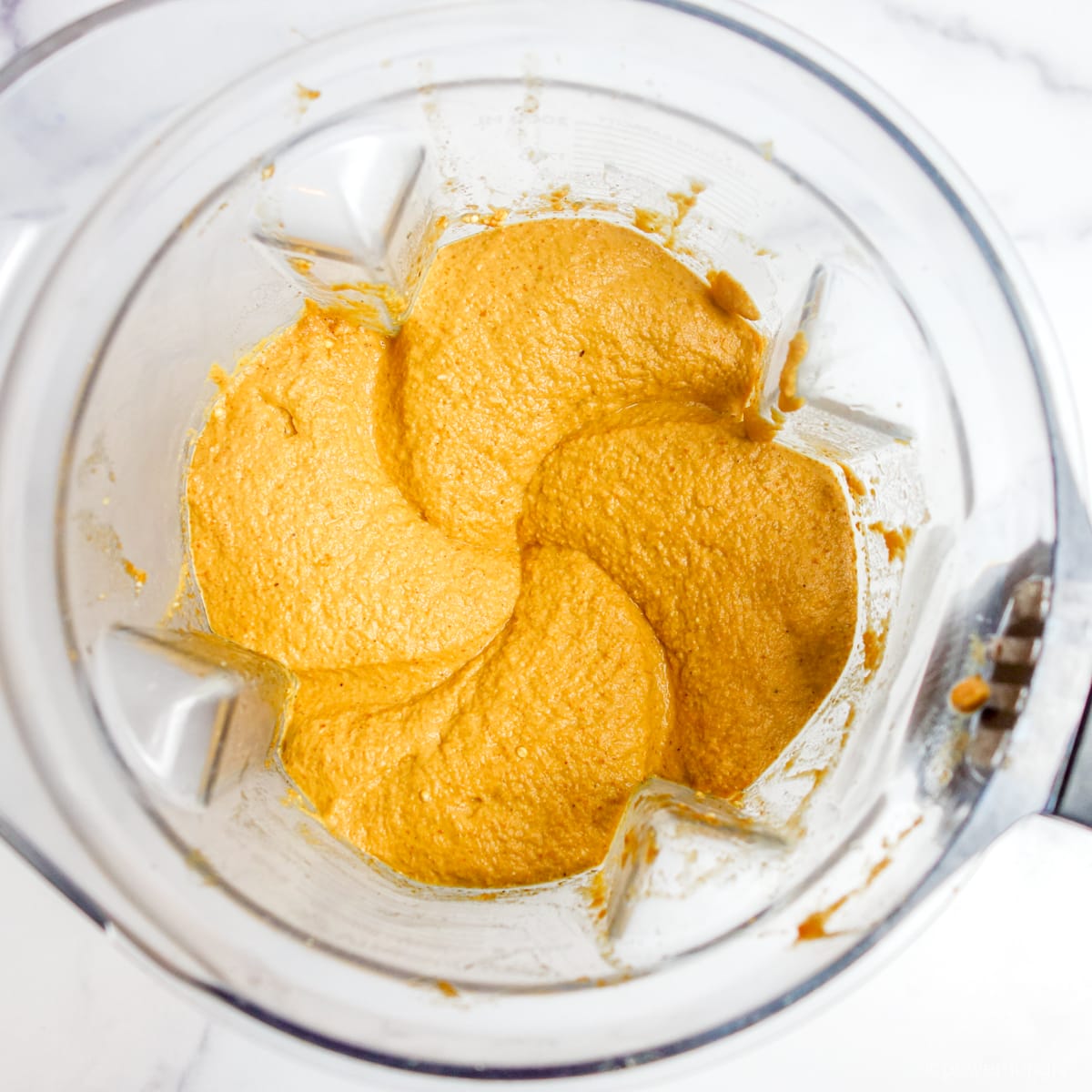
Place the millet, pumpkin, water, coconut sugar, vinegar, pumpkin pie spice, and vanilla in a blender (a high-speed or regular blender).
Blend on high speed, stopping once or twice to scrape down the sides of the blender container, until the millet is completely broken down and the batter is smooth. Pour the batter into a large bowl.
Step Three: Whisk in the Remaining Ingredients
Stir the psyllium husks, baking powder, baking soda, and salt into the batter until completely combined. Use a spatula or large spoon rather than a whisk (the batter thickens quickly and will clump on the whisk).

Why Transfer the Batter to a Separate Bowl?
When the psyllium husk is added, the batter becomes very thick and sticky. In seconds. This makes it (a) difficult to scrape the batter out of the blender and into the pan; and (2) a major task to clean out the blender.
Scraping the thickened batter out of a mixing bowl, by contrast, is quick and easy. The same holds true for the cleaning.
Step Four: Spread Batter into Pan
Scrape the batter into the prepared pan and smooth the top with a rubber spatula or the back of a spoon. The batter will be very thick.

Step Five: Bake the Bread
Bake the bread in the preheated 350F (180C) oven for 90 minutes until risen and the surface of the bread is a deep golden brown. A tester inserted near the middle of the bread should come out with only a few moist crumbs attached. The corners of the bread should be pulling away (slightly) from the pan.

Transfer the pan to a cooling rack. Cool the bread in the pan for 15 minutes.

Step Six: Remove from Pan & Cool
Remove the loaf of bread from the pan (slide a butter knife around sides, as needed, to assist the release). Place the loaf on the cooling rack and cool completely.
Slice it Thick or Thin
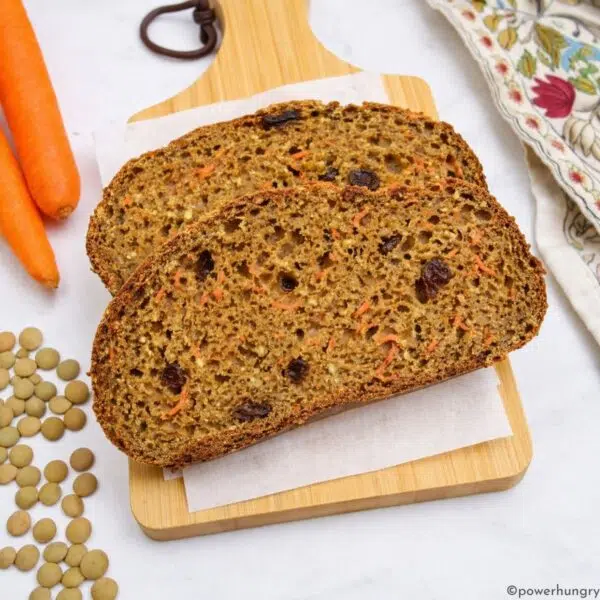
Because this is a true loaf of bread, not a loaf cake, it can be sliced thick or thin, without crumbling.

What is the texture & taste of the 100% millet pumpkin bread?
Texture: This is a very hearty, solid, fine-textured, heavy (in a very good way) bread. One slice is very filling and satisfying.
Taste: This is not an overly sweet bread, so the flavor of the pumpkin really comes through. The toasty, nutty flavor of the millet complements the pumpkin and spices.
You are welcome to add more or less sweetener, according to your preferences. I suggest taking a very small taste after blending the pumpkin and millet to assess the level of sweetness.

FAQ
How should I store the 100% Millet Pumpkin Bread?
Store the cooled bread in an airtight container at cool room temperature for 2 days, the refrigerator for 1 week, and the freezer for up to 6 months.
Can I use millet flour in place of whole millet?
Yes! Here is what you need to do to make the substitution:
(1) Use the same weight (not volume/cups) of millet flour in place of the whole millet grain. Specifically use 400 grams (about 2 and 1/2 cups) of millet flour to replace the 400 grams of whole millet.
For the most accurate results, I strongly advise weighing the millet flour for an exact weight replacement.
(2) Do not add the flour to the blender
Whisk the millet flour, psyllium, pumpkin pie spice, baking powder, baking soda and salt in the large bowl. Blend the pumpkin, water, vinegar and vanilla in the blender until smooth.
Add the pumpkin mixture to the flour mixture, stirring until blended.
Can I use a different grain in place of the millet?
I do not recommend it. The proportion of wet and dry ingredients, as well as the quantity of psyllium husk, is particular to this combination of grains. For the best results, stick with the ingredients and proportions listed.
What kind of millet do you use?
I bring this up for my international readers. In the U.S. and Canada, we pretty much have one millet available, labeled “millet.” It is small and pale yellow. It looks like bird seed because…millet is often used for bird seed (note: do not use seeds designated for birdseed in human recipes ?). The variety available for human consumption is hulled.

North American manufacturers do not specify the type of millet on packages (just “millet“), but various sources indicate that the only millet grown for human consumption in the United States is proso millet. If you have the choice of several millets in your country, opt for proso millet.
My oven has a convection setting. Should I use it for this bread?
I do not recommend it. Convection ovens are wonderful for many types of recipes, but not every recipe. Convection ovens excel at quick, crisp cooking. They are not the right choice for long slow baking, and that is definitely the case for this bread.
Convection ovens (or the convection oven setting) can force the outer layer of this bread to rise and separate from the inside of the bread. This will lead to several results: (1) a big bubble under the surface of the loaf; (2) a gooey middle and bottom; and (3) a hard outer crust.
This bread needs the moderate, radiant heat of a conventional oven.
My bread came out gooey in the middle. Why?
The bread should not be gooey at all. But if it happens, possible reasons are as follows:
- Baking in a a convection oven instead of conventional oven. See the section above explaining why this makes a huge difference.
- Inaccurate measurements. Even if you have been baking since forever, it is possible that you mis-measured. It is easy to get distracted for a split second–it happens to everybody! If you measured using cups, I urge using a scale next time around. You will love using the scale to measure once you start.
- Oven temperature is inaccurate. I regularly check my oven temperature setting using an inexpensive oven thermometer. Check to make sure the oven is accurate before baking. If the oven is too hot, it can force a faster rise to the bread, leading to a bubble under the top of the loaf.
Can I Use Something Other than Whole Psyllium Husks?
No, for this recipe it must be whole psyllium husks. Other gelling agents, such as flaxseed meal or chia seeds, will not work as direct substitutes (they might work, but it would involve some experimenting to determine their efficacy).
I have not tested this recipe with psyllium powder. It can work as a substitute for the whole husks in some recipes, but for some reason, it does not always work for when readers try to use it as a replacement. If you decide to use psyllium powder, use an equal weight (in grams).
Happy baking!

Related Recipes:

100% Millet Pumpkin Bread (V, GF, oil-free)
Ingredients
- 2 cups 400 g millet (see notes for using millet flour)
- 1 15- oz 425 g can unsweetened pumpkin puree (1 and 3/4 cups)
- 1 and 1/2 cups, 355 mL water
- 3/4 cup coconut sugar, see notes for options
- 1 tablespoon 15 mL cider vinegar (see notes for options)
- 2 teaspoons 10 mL vanilla extract
- 1/3 cup 27 g whole psyllium husks
- 2 teaspoons baking powder
- 2 and 1/2 teaspoons pumpkin pie spice, see notes for option
- 3/4 teaspoon salt
- 1/2 teaspoon baking soda
Instructions
- Preheat the oven to 350F(180C). Note: I advise against using the convection setting for this bread (see post for explanation). Spray or grease a 9×5-inch (22.5×12.5 cm) loaf baking pan.
- Place the millet, pumpkin, water, coconut sugar, vinegar, pumpkin pie spice, and vanilla in a blender container. Blend on high, stopping once or twice to scrape down the container, until smooth.
- Pour the pumpkin mixture into a large bowl. Stir in the psyllium husks, baking powder, baking soda, and salt until blended (it will become very thick, very quickly).
- Spread the batter into the prepared loaf pan, smoothing the top (it will be very thick)..
- Bake in the preheated oven for 80 to 90 minutes until a deep golden brown and a tester inserted in the middle of the loaf comes out with only a few moist crumbs attached.
- Cool in the pan, on a cooling rack, for 15 minutes.Remove the bread from the pan and cool completely on the cooling rack before slicing.


Can you please let me know, if I can use Ragi(Finger millet) flour in place of millet flour ?
Hi Viji! I am sure that will work fine. I cannot test it, to make certain, because it is not available in the United States. I would love to know if you try it. Cheers.
I love the consistency of this bread. Do you think it would work to leave out the sugar for a more savory or neatral bread?
Hi Michele,
I am so glad that you like the bread! Yes, you can definitely leave out the sugar for a savory bread. You may want to add and extra tablespoon or two of water to the batter (to make up for the moisture that the sugar adds). You could keep it plain or add savory herbs or spices 🙂 Great idea!
How do you think this will turn out with raisins?
That would be great, Cindy (I love raisins 🙂 The batter is quite thick so three should be little to now chance of them drifting to the bottom of the loaf. Cheers.
I used about a cup of raisins and it turned out great! Love this recipe!
Yay! I am so glad, Cindy, enjoy!
This is great but I used millet flour, not whole millet. There is a bitter aftertaste – I’ve used whole millet in other recipes and don’t recall an aftertaste. Is that something that millet flour does?
Hi Bronsa,
One thing I have learned the hard way is that millet flour can turn rancid VERY quickly. Sometimes brand new bags already have a slightly bad aftertaste (the bitterness you describe). If possible, try to grind it fresh, yourself (easy in a high speed blender, or even a regular blender) and store any leftovers in an airtight bag/container in the freezer. Cheers.
So much better with whole millet! But my regular blender struggled with it being so thick even with just water, millet and pumpkin. I ended up needing to switch to my food processor and added a few more tablespoons water. Next time should I try to process whole millet into flour first?
Hi Bronsa,
Oh good glad whole millet worked out better! Sorry for the struggles with the regular blender. I suggest blending just the water and millet until smooth for the regular blender (keep blending until it looks like milk, it will take a few minutes to completely break down the millet). Then add the other ingredients list for the blending phase (i.e., pumpkin, coconut sugar, etc). That should do the trick!
I have made your millet bread many times and everyone was great and a new taste, because I added all types of savories (olives, green chile, and such). I was going to try the pumpkin millet and noticed it called for 2 cups or 400 grams of millet. The original recipe calls or 2 1/2 cups or 400 grams of millet. Assume the pumpkin recipe is 2 cups millet (and therefore not 400 grams) but wanted your confirmation.
Hi Mitch! I am so glad you like the millet bread and have tried so many variations (sounds so good!).
I use a different method with the pumpkin millet bread. I use whole millet instead of millet flour. I have instructions for using millet flour in the recipe, too. So the 2 cups (400 g) is referring to the wright of whole millet rather than millet flour (the latter has a greater volume). Cheers.
Thank you for this recipe. I’ve made your regular millet bread recipe a few times and really love that, so I can’t wait to try this one. Making it to take to family for Christmas!
Hi ,
I already commented yesterday , this morning a toasted a slice like a toast , my slice looked like raisin bread because I added dried raisins , it was the best I added butter it almost tasted like cinnamon raisin bread . I already reduced the sugar in this recipe making it perfect . Next time I make it , I will use only 1/3 cup maple syrup no sugar , I know this can be successful because I added 2 tbs of molasses and it baked beautifully! Thank you again for this nutritious bread without the fat , eggs and milk this reduce the calories by a lot .
Brigitte,
I am so thrilled that you love the bread 🙂 It is my pleasure to create and share them–thank you so much for taking the time to post your comments! As a confirmed raisin aficionado, I love that that you added resins to the recipe!
This bread is fantastic , I might have over baked it by 10 minutes , I just red you mentioned to check the temperature in the corner and a few crumbs can still be on the tooth pick . Next time I will bake it for 80 minutes , I reduced the sugar to 1/3 cup and added 2 tbs of molasses , I also added raisins and topped the bread with pumpkin seeds . It’s so healthy it’s crazy good , I have one question should I rincée the millet before using ? Thank you
Brigitte, I love that you decided to sub some molasses, I have to try that (love it). So happy that you like the bread!
Can I add a little bit of oil to this recipe? Whether it’s the pumpkin millet bread or just plain millet Bread?
Hi Karen,
Yes, definitely! Replace some of the eater with the amount of oil you would like to add.It will make a moister bread.
Greetings from Vancouver (BC), Camilla! This is a delicious recipe and I’ve made it a few times. Sometimes I use applesauce instead of pumpkin and it’s just as yummy.
My only oven is a convection toaster oven and I don’t have a loaf pan, but that didn’t stop me from making this bread. I bake it in an 8×8 silicone dish at 325F with the fan for about 35 minutes. I just thought I’d share that for others who may want to bake it differently as well.
Thank you for your recipes – we also enjoy your almond flour cookie recipe.
Hi Sabine! I love Vancouver, so a huge hello (my mother is Canadian). Thank you SO much for sharing how you adapted the recipe for your convection oven, that is brilliant! I know that will be such a help to so many people. Thanks so much for sharing!
This is a lovely recipe. I didn’t have the right size loaf pan, so I baked it in a square baker, like cornbread. Worked just fine. I like that it’s not overly sweet. Perfect for all kinds of sweet and savory toppings!
Hi Karen–how smart! I am guessing that cut back the baking time, too, which is great 🙂 So happy you like the recipe (yay! I have eaten it with savory toppings, too! My husband though I was crazy when I spread some red pepper-olive tapenade on it, but it was delicious!)
This was so good!! I’ll have to make extra next time
Thanks for trying it, Jessica, and so happy you like it!
This bread is out of this world! Made it exactly as written except substituted Monk sugar for the coconut sugar. Will definitely be making this again!
Oh wow, I am thrilled to hear that you like it so much, Catherine! 🙂